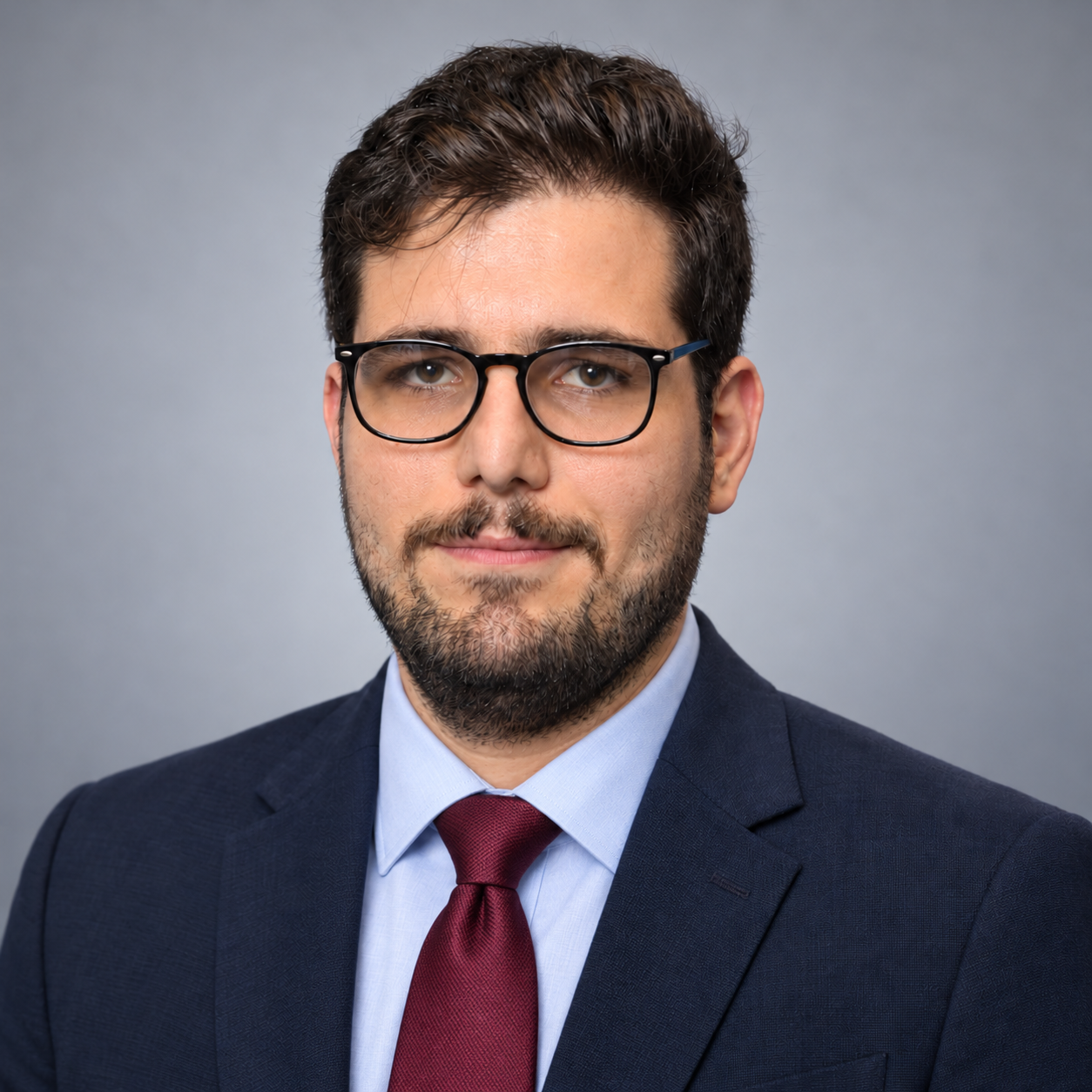
Seyed Milad Hatamlee
COMPUTATIONAL MATERIALS & MOLECULAR SIMULATION
Molecular insight. Engineering understanding.
I am Seyed Milad Hatamlee, a computational materials researcher and mechanical engineer based in Palo Alto, California. I earned my Ph.D. at the University at Buffalo in 2026. My research uses molecular dynamics, Monte Carlo simulation, lattice dynamics, and thermodynamic modeling to investigate heat transfer, mechanical response, and fluid behavior at the nanoscale.
I develop and validate atomistic models, automate simulation workflows, and analyze how chemistry, defects, interfaces, and confinement influence material properties. I also use regression and numerical optimization to identify structure–property relationships and calibrate physical models against molecular simulation data.
Research focus
- Confined fluids and thermodynamics: pressure-driven water and CO₂ transport, adsorption, binary-mixture phase equilibrium, and equation-of-state modeling.
- Thermal transport and interfaces: heat conduction in two-dimensional materials, interfacial thermal conductance, and vibrational mechanisms.
- Atomistic mechanics and adhesion: tensile and shear response, defects, surface termination, and mineral–water interfaces.
- Data-driven physical modeling: regression-based structure–property relationships, parameter estimation, numerical optimization, and simulation workflow automation.
Selected research contributions
- Simulation workflow development: Automated submission and analysis supporting high throuput confined-fluid simulations, with benchmarking and data collection.
- Interfacial heat transfer: Combined non-equilibrium molecular dynamics and lattice dynamics across 15 two-dimensional interfaces to investigate how localized interfacial vibrations relate to thermal conductance.
- Thermodynamic model calibration: Calibrated attraction and covolume corrections in a modified Peng–Robinson model, reducing normalized phase-envelope RMSE by 27–61% against Monte Carlo reference data at the fitted conditions.
How I work
I use LAMMPS and Towhee for molecular simulation, GULP for lattice dynamics, and Python and MATLAB for workflow automation, analysis, regression, and optimization. I use density functional theory with VASP and Quantum ESPRESSO for structural relaxation and geometry optimization of initial atomistic models. My work emphasizes validation, sensitivity analysis, and physical interpretation.
Recent work
- Accepted in Langmuir (2026): Monte Carlo informed modification of the Peng–Robinson equation of state for CO₂/hydrocarbon mixtures confined in nanopores.
- Published in Journal of Molecular Liquids (2026): Molecular dynamics study of fluid flow in silica nanochannels.
Let’s connect
I welcome conversations about postdoctoral research, computational materials and simulation roles, and collaborations in the San Francisco Bay Area. Get in touch →