
Thermal Transport Across Gold–Silica Interfaces
Research question
How do silica structure, interface coupling, and temperature influence heat transfer across a gold–silica interface?
My contribution
- Used non-equilibrium molecular dynamics to compare planar gold interfaces with crystalline and amorphous silica.
- Prepared amorphous silica structures and examined their atomic structure.
- Extracted interfacial conductance from heat flow and the temperature discontinuity across the interface.
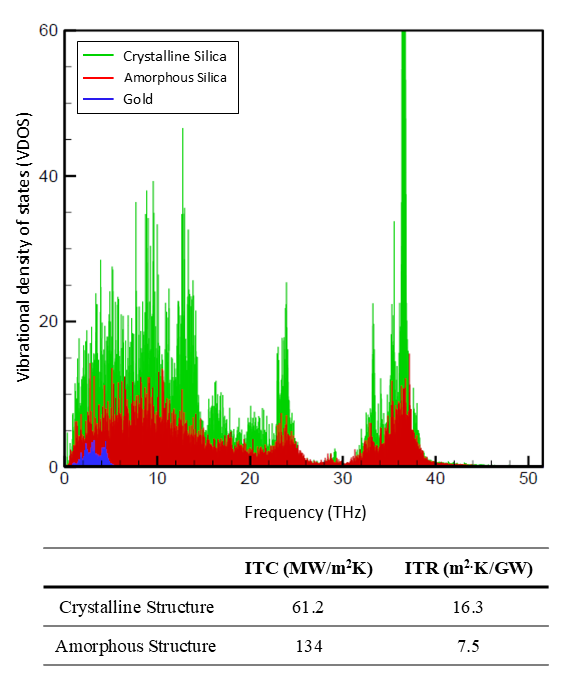
- Investigated interface coupling strength and temperature, and used vibrational density-of-states analysis to interpret the trends.
- Compared atomistic results with a diffuse mismatch model.
Principal findings
The simulations gave higher interfacial conductance for amorphous silica than crystalline silica under the studied conditions. Increasing interface coupling improved conductance before it approached a plateau. Vibrational analysis helped explain how silica structure influenced interfacial energy transfer.
This project connects atomistic interface structure with thermal resistance and illustrates the limits of simplified analytical descriptions for these interfaces.
Methods
LAMMPS classical MD and NEMD; amorphous-structure preparation; temperature-profile and heat-flow analysis; vibrational density of states; parameter sweeps; repeated simulations and analytical-model comparison.
Simulation results
Related publication
Hatam-Lee SM, Jabbari F, Rajabpour A. Interfacial thermal conductance between gold and SiO₂: A molecular dynamics study. Nanoscale and Microscale Thermophysical Engineering, 26(1):40–51, 2022. Read the article.