
Mineral Adhesion and Biocementation
Research question
Why can soils with similar geotechnical properties develop different strengths after enzyme-induced carbonate precipitation, and what role do mineral chemistry and interfacial water play?
My contribution
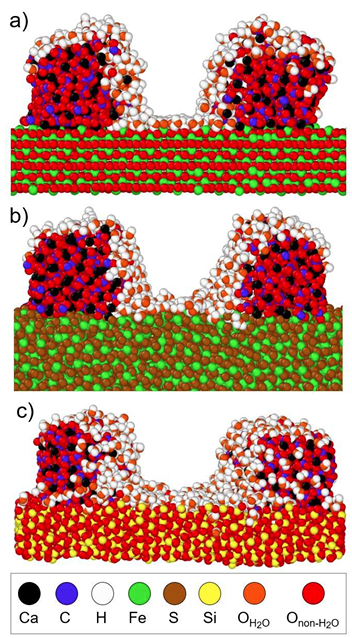
- Modeled interfaces between preformed calcite and quartz, hematite, or marcasite.
- Compared dry and hydrated interfaces to quantify how water changes binding and adhesion.
- Analyzed electrostatic and van der Waals contributions, density profiles, and water redistribution near mineral surfaces.
- Interpreted the molecular findings alongside laboratory compression results obtained by collaborators.
Principal findings
Mineral surface chemistry changed calcite adhesion, while hydration altered interfacial interactions in a substrate-dependent manner. Water redistribution provided a molecular explanation for differences observed in the experimental biocementation study.
The simulations examined adhesion between existing mineral phases. They did not model enzyme kinetics, carbonate nucleation, or the complete macroscopic soil compression test.
Methods
LAMMPS classical MD; dry and hydrated mineral-interface models; binding-energy and adhesion analysis; interaction-energy decomposition; density profiles; repeated simulations and atomistic visualization.
Simulation setup and Results
Related publication
Ghasemi H, Hatam-Lee SM, Tirkolaei HK, Yazdani H. Biocementation of soils of different surface chemistries via enzyme induced carbonate precipitation (EICP): An integrated laboratory and molecular dynamics study. Biophysical Chemistry, 284:106793, 2022.