
Adsorption and Transport in Zeolite 13X
Overview
This project investigates the adsorption and transport behavior of CO₂ and water in nanoporous materials, with a focus on Zeolite 13X. Using molecular simulations, this work aims to understand how confinement and pore structure influence fluid distribution, adsorption mechanisms, and transport dynamics at the nanoscale.
Motivation
Nanoporous materials such as zeolites play a critical role in gas separation, carbon capture, and energy systems. However, fluid behavior in these materials can differ significantly from bulk systems due to confinement, surface interactions, and pore geometry.
This work explores how these factors influence adsorption and transport of CO₂ and water, with implications for carbon capture and storage technologies.
Approach
- Molecular simulation of confined systems
- Modeling adsorption behavior of CO₂ and water in zeolite structures
- Analysis of fluid distribution and transport mechanisms within nanopores
- Investigation of coupling between adsorption and flow behavior
Research Focus
- Understanding adsorption mechanisms in nanoporous materials
- Studying the interaction between CO₂, water, and pore surfaces
- Investigating how confinement alters fluid structure and mobility
- Exploring transport behavior in highly confined environments
Simulation Snapshots
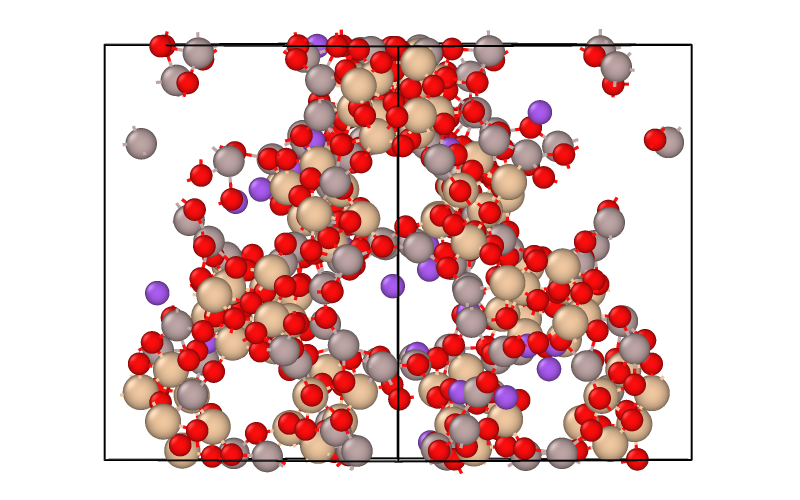

Example molecular configuration showing adsorption of fluid species within nanopores.
Ongoing Work
This research is currently under development, with detailed results being prepared for journal publication.